
The Growth Loop: Why Acquisition Without Retention Is a Leaky Bucket
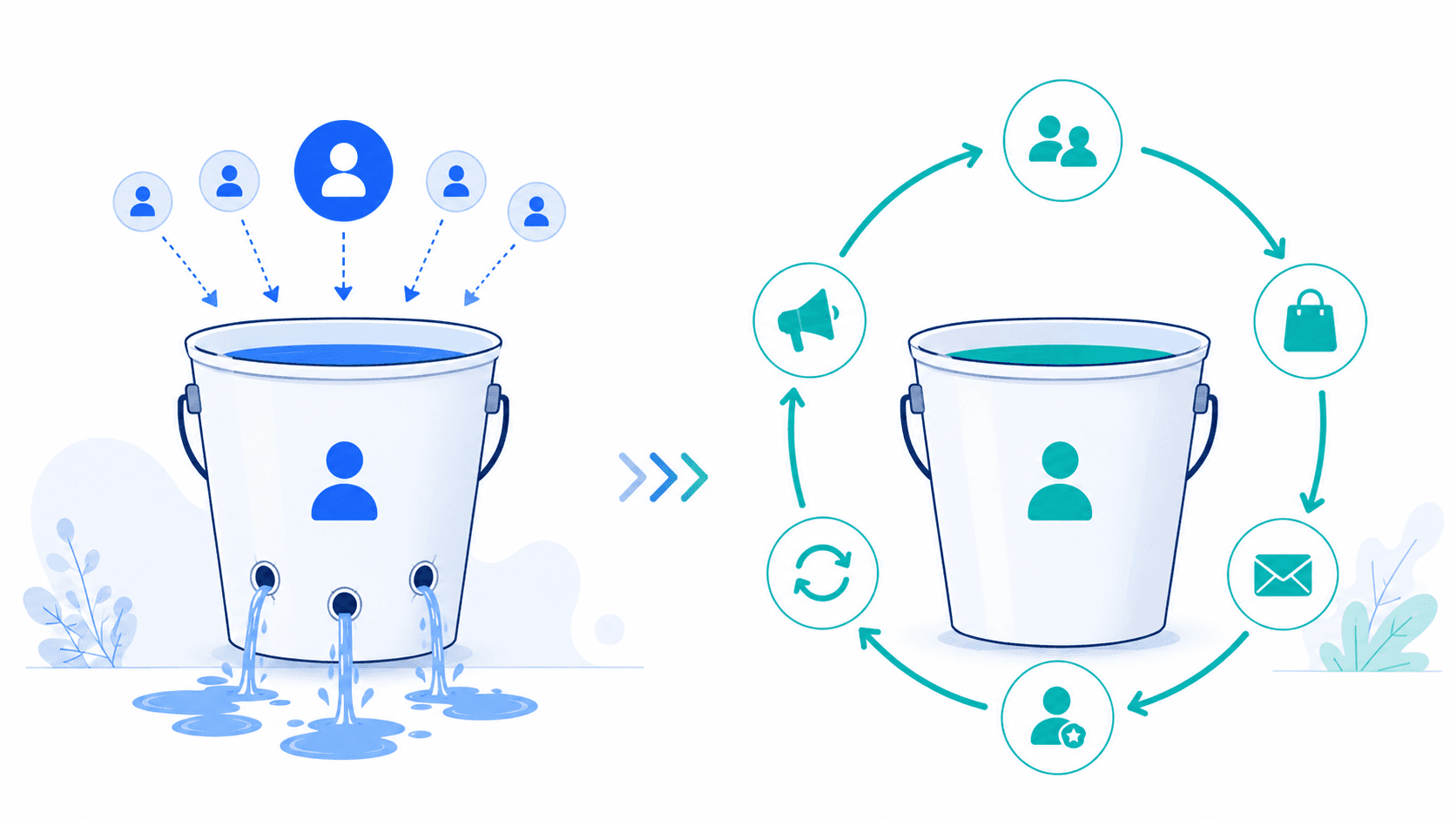
Customer acquisition cost has been rising across nearly every paid channel for years. Auction-based ad platforms get more expensive as more advertisers compete for the same attention, and privacy changes have made it harder to target and measure who actually converts. For most businesses, this means the acquisition side of growth marketing is structurally getting harder and more expensive, not easier.
Despite that, most growth budgets are still allocated almost entirely to acquisition. New ads, new campaigns, new channels, all aimed at people who have never heard of the business before. Meanwhile, the customers who already purchased, already trust the brand, and already understand the product get comparatively little investment after the sale closes. This is the leaky bucket problem: pouring water in at the top while it drains just as fast out the bottom.
The Math That Makes Retention Non-Negotiable
The relationship between customer lifetime value and customer acquisition cost, usually shortened to LTV:CAC, is one of the clearest indicators of whether a growth strategy is sustainable. A healthy ratio is generally considered to be around 3:1 or higher: a customer needs to be worth at least three times what it costs to acquire them for the economics to hold up once overhead, support, and fulfillment costs are factored in.
Retention directly increases the LTV side of that ratio without touching the CAC side at all. A customer who buys twice instead of once, or who stays subscribed for eighteen months instead of six, makes every dollar spent on acquiring them work harder. This is the fastest lever available to improve unit economics, because it does not require negotiating better ad rates or finding a cheaper channel. It requires keeping the customers already paid for.
Why Acquisition-Only Strategies Feel Like a Treadmill
A business that only invests in acquisition experiences a very specific kind of frustration: revenue that requires constant new spend just to stay flat. Each month starts from zero. There is no carryover benefit from last month's customers because they were never given a reason to return, so this month's growth depends entirely on this month's ad budget.
This is structurally different from a business with a working retention system, where last month's customers are still generating revenue this month through repeat purchases, subscription renewals, or referrals, on top of whatever new customers this month's acquisition spend brings in. One pattern compounds. The other resets every thirty days.
What a Retention System Actually Requires
Retention is not a single tactic. It is a set of systems that respond to where a customer is in their relationship with the business. A welcome and onboarding sequence that gets a new customer to their first meaningful use of the product quickly, since customers who don't experience value early rarely stick around long enough to buy again.
Lifecycle email flows tied to behavior, not just time: a different message for someone who purchased once versus someone who purchased five times, versus someone who has gone quiet for sixty days. A win-back sequence for lapsed customers, since re-engaging someone who already knows the brand is almost always cheaper than acquiring someone new who has never heard of it.
Engagement scoring that flags at-risk customers before they churn rather than after, so intervention happens while there is still time to change the outcome. And a feedback loop from customer support and reviews back into product and messaging, since retention problems are often signals of a real gap, not just a communication gap.
The Growth Loop, Not the Growth Funnel
The traditional funnel model treats growth as linear: awareness, consideration, purchase, done. A growth loop model treats the end of one cycle as the input to the next. A retained customer refers a friend. That friend becomes a new acquisition, at a lower cost than a cold ad click, because referred customers already come with a level of trust the brand hasn't had to earn from scratch. That new customer, retained well, refers someone else.
This is why retention and referral are often described as the compounding half of growth marketing. Acquisition adds customers one at a time, at a cost that tends to rise over time. A working loop adds customers through the customers already earned, at a cost that tends to fall as the loop matures and the retained base grows.
The Practical Starting Point
For a business trying to fix a leaky bucket, the starting point is rarely a new acquisition channel. It is answering a smaller set of questions: what percentage of customers make a second purchase, how long does it take before they do, and what happens to the customers who don't. Most businesses have never actually pulled these numbers, which means they are running an acquisition strategy without knowing whether the bucket even holds water.
Fixing that leak, even partially, tends to move revenue further than the next acquisition channel would, and it moves it in a way that keeps compounding instead of resetting every month.